Conventional Non-Destructive Testing
At ITIS, we tackle complex inspection challenges with innovative NDT solutions. Our certified experts use advanced technologies to deliver faster, more accurate, and cost-effective results—ensuring compliance, reliability, and improved performance across industries.
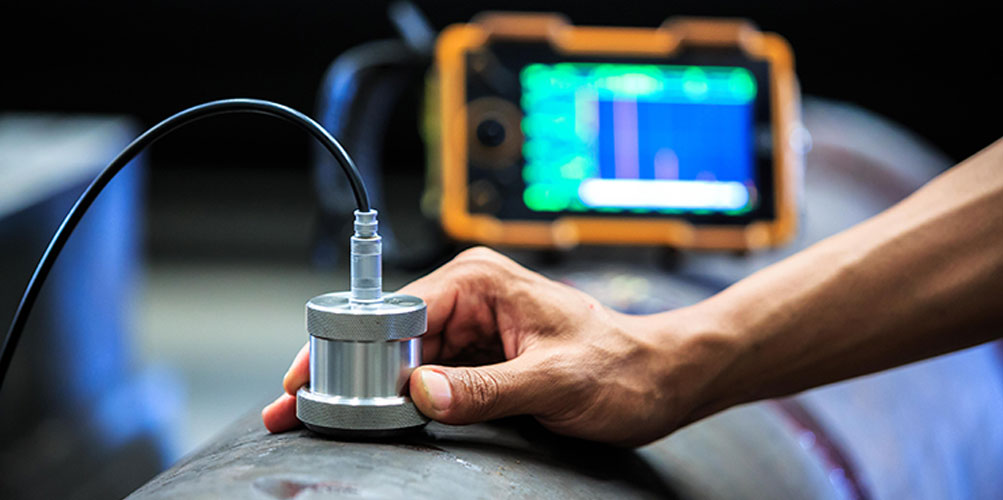
Non-Destructive Testing (NDT) involves detecting flaws in materials without causing damage. It ensures safety, quality control, and plant life assessment. Common flaws include cracks, inclusions, or structural inconsistencies. ITIS offers certified, experienced professionals skilled in conventional NDT methods, adhering to international standards like PCN, ISO 9712, ANSI CP-189, and SNT-TC-1A.
NDT Services that ITIS can provide
Ultrasonic Thickness Testing (UTT)
Ultrasonic Thickness Testing (UTT) is a method of performing non-destructive measurement (gauging) of the local thickness of a solid element based on the time taken by the ultrasound wave to return to the surface. It is widely used to monitor corrosion or erosion in pipelines, tanks, and structural components.
Radiographic Testing (RT)
Radiographic Testing (RT) uses X-rays or gamma rays to detect internal defects in materials or welds. The radiation passes through the object and exposes a film or digital detector, creating an image that reveals cracks, porosity, inclusions, or incomplete fusion.
Magnetic Particle Testing (MPT)
Magnetic Particle Testing (MPT) is used to detect surface and near-surface discontinuities in ferromagnetic materials. The part is magnetized, and iron particles are applied. Flaws disturb the magnetic field and attract the particles, forming visible indications.
Dye Penetrant Testing (DPT)
Dye Penetrant Testing (DPT) is a surface inspection method used to detect cracks, seams, or other surface-breaking defects in non-porous materials. A dye is applied and seeps into flaws; after removal and application of a developer, flaws become visible.
Ferrite Testing (FT)
Ferrite Testing is used to measure the percentage of delta ferrite in austenitic stainless steel welds and components. Accurate ferrite content is essential to prevent cracking and corrosion, especially in high-temperature or corrosive environments.
Visual Inspection (VT)
Visual Inspection (VT) is the most basic and essential form of NDT. It involves the direct examination of components using the naked eye or with aids like borescopes, mirrors, and cameras to detect visible defects, surface cracks, or misalignments.
Radiographic Testing – SCARPRO
SCARPro (Small Controlled Area Radiography) is a specialized radiographic technique using compact X-ray sources and lead shielding, allowing safer inspection in confined spaces with reduced exclusion zones. It’s ideal for piping and weld inspection in active facilities.
Digital Radiography (DR)
Digital Radiography (DR) is a modern radiographic method using digital detectors instead of traditional film. It offers faster image acquisition, enhanced defect visibility, and immediate analysis, making it efficient for weld inspection, casting evaluation, and corrosion detection.
Ultrasonic Shear Wave Testing (UT - Angle Beam)
Ultrasonic Shear Wave Testing uses angled ultrasonic beams to detect flaws in welds and structural materials. It is highly effective in locating planar defects like lack of fusion or cracks that are not detectable with straight-beam UT.
Post Weld Heat Treatment (PWHT)
Post Weld Heat Treatment (PWHT) is a controlled heating and cooling process applied to welded components to reduce residual stresses, improve mechanical properties, and enhance structural integrity. It is commonly required for pressure vessels, piping, and structural welds to comply with industry codes such as ASME and API.
Positive Material Identification (PMI)
Positive Material Identification (PMI) is a non-destructive testing method used to verify the chemical composition of metallic materials. It ensures the correct alloy grade is used and helps prevent material mix-ups in critical components like piping, valves, and fittings.
Ready to Enhance Your Team's Capabilities?
Contact us today to discuss your corporate training needs and how we can help your organization achieve its goals.
Get in Touch